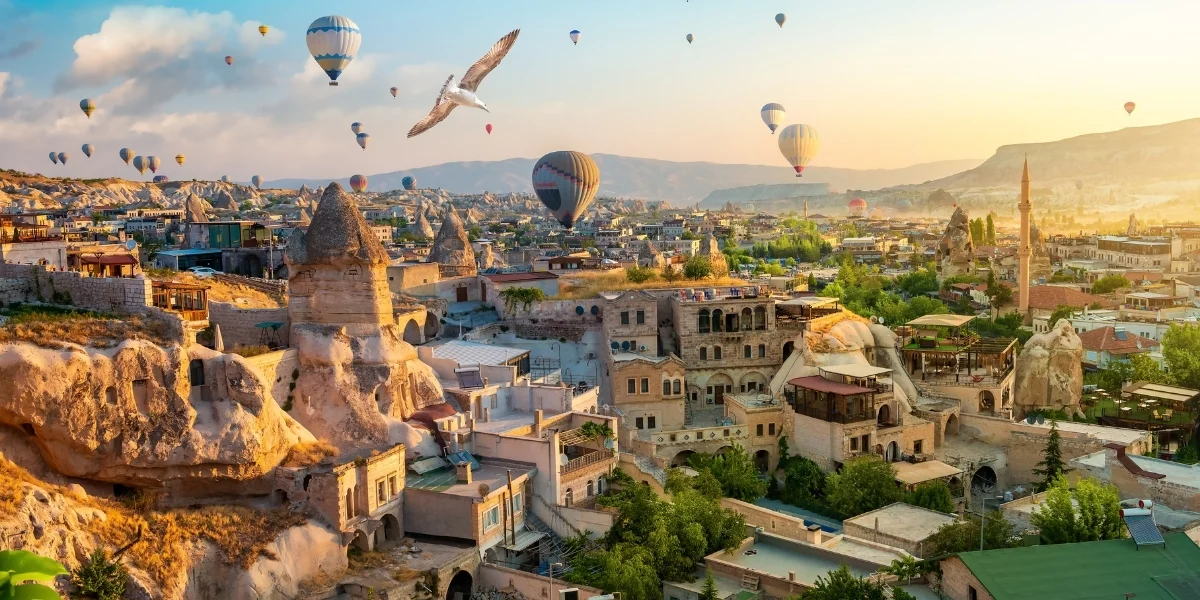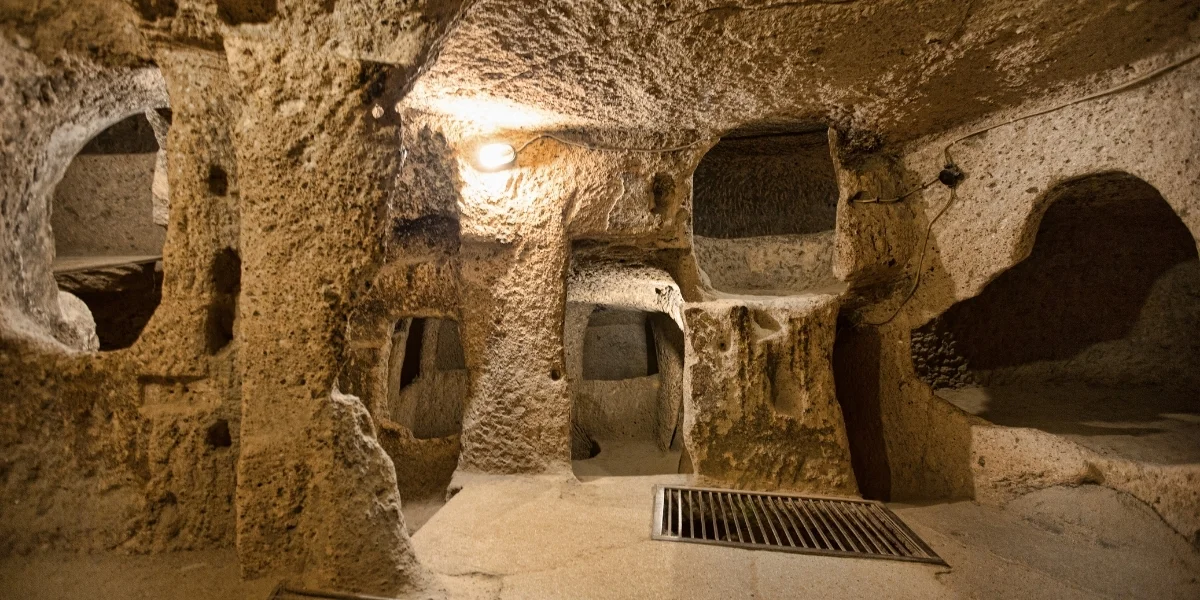
Beneath the fairy chimneys of Cappadocia lies a network of underground cities carved into soft volcanic rock. Over many centuries local communities dug these refuges to shelter from raids and persecution, and early Christian communities enlarged them into complete settlements with stables, chapels, kitchens and storerooms below ground. Derinkuyu and Kaymaklı are the two largest that are open to visitors, and a walk through their tunnels shows clearly how people adapted their lives to this landscape.
How the underground cities came to be
The plateau around Nevşehir is covered by thick layers of tuff, a rock formed from volcanic ash. Newly exposed tuff is soft enough to cut with simple iron tools, yet it hardens once it meets the air, which made it possible to dig deep rooms that still stand today. The earliest chambers are thought to be very old, and historians still debate who began them. What is clear is that the cities grew level by level over a long period, as each generation extended the rooms and passages it inherited.
In times of danger, whole villages could move underground with their animals and food supplies. Heavy stone doors closed the passages from inside, narrow corridors slowed down intruders, and vertical shafts brought air and water to the lower floors. When the threat passed, people returned to their homes on the surface, and the cities were used again as cellars, stables and cool storage.
Derinkuyu: eight levels below the plain
Derinkuyu is the deepest of the underground cities open to the public, reaching 8 levels and more than 60 metres below the surface. Its rooms include stables near the entrance, a chapel, wine cellars, communal kitchens blackened by smoke, and ventilation shafts that run down through the whole complex. It is said that the city could shelter around 20,000 people together with their livestock. The missionary level, found in 1963, is part of the route on our Green Tour through Derinkuyu and Ihlara Valley, which covers all eight accessible levels.
The descent is gradual but steep in places. Passages narrow between the halls, ceilings drop low, and the air becomes cooler and stiller as you go down. Lighting has been installed along the visitor route and signs mark the way down and back up, so the visit follows a clear one-way circuit through the main rooms.
Kaymaklı: wide halls closer to the surface
Kaymaklı spreads out more horizontally than Derinkuyu, and 4 of its levels are open to visitors. Its passages are often narrower and lower, but its living quarters, storerooms and workshops are well preserved, with niches for storage jars and pressing basins cut into the rock. According to local tradition, a tunnel of about 8 km once linked Kaymaklı with Derinkuyu, although no such route is open to visitors today.
Our Blue Tour through Rose Valley and Çavuşin ends the day with a guided visit to Kaymaklı or Özkonak Underground City, after a hike of about 4 km through Rose Valley and Red Valley. In a single day you see both the open valleys and the hidden rooms beneath them.
What you will see underground
- Rolling stone doors: round stone wheels of up to 500 kg that were rolled across the passages and could only be moved from inside
- Ventilation shafts: vertical channels that carry air down to the lowest floors and also served as wells
- Chapels: simple places of worship with carved crosses and cross-shaped plans
- Storerooms: cellars for wine and grain, with niches for jars and pressing basins
- Living quarters: family rooms with stone benches and beds, and kitchens darkened by centuries of smoke
Visiting tips for narrow passages
The underground cities stay cool all year round, which makes them a pleasant break on a hot summer day, while in winter they feel milder than the wind on the plateau. A light extra layer is useful in every season. Floors are uneven and can be slippery, so comfortable shoes with good grip matter more than anything else you pack.
- Some tunnels require crouching for several metres, so visitors with claustrophobia or with back or knee problems can stay on the upper levels and wait near the exit.
- Large backpacks get in the way in narrow passages; a small bag leaves your hands free for the handrails and the low ceilings.
- Morning visits avoid the afternoon crowds, when tour groups queue at the narrowest stairways.
- A guide who explains the history brings the rooms to life, because without context many spaces look alike.
Photography is allowed in most areas, but the light is dim. A phone camera in night mode gives a more faithful result than a flash, which flattens the texture of the rock and disturbs other visitors.
Other underground sites and private routes
Özkonak, north of Avanos, and Mazi, a smaller site inside a village, are less crowded alternatives with the same rolling stones and ventilation shafts. Visiting more than one city shows how each community adapted the design to its own hillside, from the deep vertical layout of Derinkuyu to the broader floors of Kaymaklı.
For a day planned around your own interests, our private tour with your own vehicle and driver-guide follows one of four ready routes or a custom plan, so several underground sites can be combined with valleys or villages. On this tour, entrance fees are paid directly at each site. To plan your visit, contact us and we will help you put the day together.
Ready to Explore?
Book your next adventure with Cave Land Travel A-9394 and experience the magic yourself!
Browse Our Tours